

Description
Knowledge Translation in Health Care is a practical introduction to knowledge translation for everyone working and learning within health policy and funding agencies, and as researchers, clinicians and trainees. Using everyday examples, it explains how to use research findings to improve health care in real life.
This new second edition defines the principles and practice of knowledge translation and outlines strategies for successful knowledge translation in practice and policy making. It includes relevant real world examples and cases of knowledge translation in action that are accessible and relevant for all stakeholders including clinicians, health policy makers, administrators, managers, researchers, clinicians and trainees.
From an international expert editor and contributor team, and fully revised to reflect current practice and latest developments within the field, Knowledge Translation in Health Care is the practical guide for all health policy makers and researchers, clinicians, trainee clinicians, medical students and other healthcare professionals seeking to improve healthcare practice.
Summary
Health care systems worldwide are faced with the challenge of improving the quality of care and decreasing the risk of adverse events. The finding that providing evidence from clinical research is necessary but not sufficient for delivering optimal care has created interest in knowledge translation (KT) – the scientific study of methods for closing the knowledge-to-practice gap, and of the barriers and facilitators inherent in this process. Policy makers, funding agencies, clinicians, and researchers recognize the need to facilitate the implementation of knowledge into practice. Implementing evidence can lead to improvements in cost and outcomes.
This website is based on the publication “Knowledge Translation in Health Care: Moving from Evidence into Practice” by Sharon E. Straus, Jacqueline Tetroe, and Ian D. Graham. This publication uses the knowledge-to-action cycle as a guiding framework to define and describe KT. It also outlines strategies for enhancing KT capacity and implementing of KT activities.
Knowledge Translation
The Canadian Institute of Health Research has defined knowledge translation as “a dynamic and iterative process that includes synthesis, dissemination, exchange and ethically-sound application of knowledge to improve the health of Canadians, provide more effective health services and products, and strengthen the health care system”.
The significance of KT is that knowledge creation (first-generation research), distillation (creation of systematic reviews or second-generation research), and dissemination (appearance in journals) are not usually sufficient on their own to ensure appropriate knowledge use in decision making. Increasing recognition of these knowledge-to-action gaps has led to attempts to effect behaviour, practice, or policy change. Efforts must be made to close the knowledge-to-action gaps by using effective knowledge translation interventions, which can thereby improve health outcomes.
Knowledge translation research aims to improve health care settings by doing the following.
- Exploring how to measure gaps in decision making.
- Improving knowledge synthesis and distillation.
- Enhancing methods for diagnosing and measuring the determinants of knowledge uptake.
- Determining the effectiveness and sustainability of different KT approaches and effect modifiers.
Knowledge-to-Action Cycle
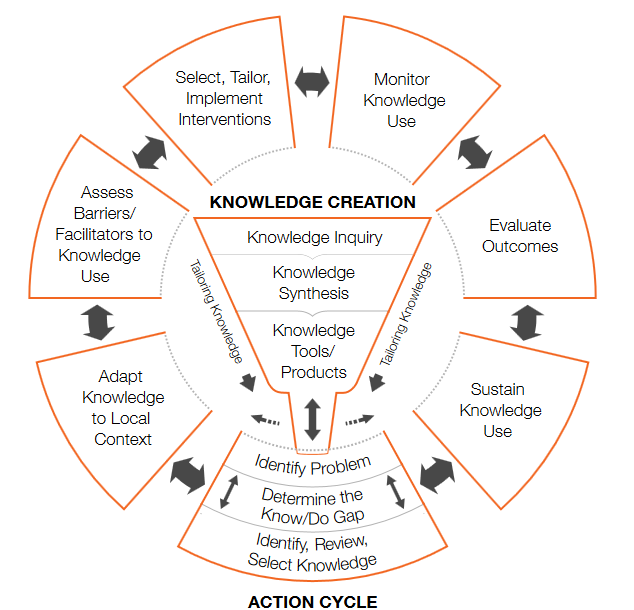
The knowledge-to-action cycle is a conceptual framework developed by Graham and colleagues that is built on the commonalities found in an assessment of >30 planned-action theories. The knowledge-to-action cycle is an iterative, dynamic, and complex process. It involves both knowledge creation and knowledge application (action cycle) with the boundaries between the creation and application components being fluid.
Additional Resources
CIHR has compiled a series of PowerPoint presentations that were prepared by the authors of this publication, based on the chapter(s) that they wrote. The content in these slides is meant to complement, rather than to replace the original chapters. We invite you to use these slides for your learning and/or training activities. If you would like additional information on the content of the slides, please refer to the Knowledge Translation in Health Care book.
Please note that these presentations are based on the first editions of this publication.
Section 1: Introduction
- Knowledge-to-action: what it is and what it isn’t
(Sharon E. Straus, Jacqueline Tetroe, Ian D. Graham)
Section 2: Knowledge Creation
- 2.1 The K in KT: knowledge creation
(Sharon E. Straus) - 2.2 Knowledge synthesis
(Jennifer Tetzlaff, Andrea C. Tricco, David Moher) - 2.3 Knowledge translation tools
(Melissa C. Brouwers, Dawn Stacey, Annette M. O’Connor) - 2.4 Searching for research findings and KT literature
(K. Ann McKibbon, Cynthia Lokker)
Section 3: The Knowledge-to-Action Cycle
- 3.1 The action cycle
(Sharon E. Straus) - 3.2 Identifying the knowledge-to-action gaps
(Alison Kitson, Sharon E. Straus) - 3.3 Adapting knowledge to a local context
(Margaret B. Harrison, Ian D. Graham, Beatrice Fervers) - 3.4 Assessing barriers and facilitators to knowledge use
(France Légaré) - 3.5 Selecting KT interventions
- 3.5.1 Selecting, tailoring and implementing knowledge translation interventions
(Michel Wensing, Marije Bosch, Richard Grol) - 3.5.2 Educational interventions
(Dave Davis, Nancy Davis) - 3.5.3 Linkage and exchange interventions
(Martin P. Eccles, Robbie Foy) - 3.5.4 Audit and feedback interventions
(Robbie Foy, Martin P. Eccles) - 3.5.5 Informatics interventions
(Samir Gupta, K. Ann McKibbon) - 3.5.6 Patient-mediated interventions
(Annette M. O’Connor) - 3.5.7 Organizational interventions
(Ewan Ferlie)
- 3.5.1 Selecting, tailoring and implementing knowledge translation interventions
- 3.6 Monitoring and evaluating knowledge
- 3.6.1 Monitoring knowledge use and evaluating outcomes of knowledge use
(Sharon E. Straus, Jacqueline Tetroe, Ian D. Graham, Merrick Zwarenstein, Onil Bhattacharyya) - 3.6.2 Framework for evaluating complex interventions
(Sasha Shepperd)
- 3.6.1 Monitoring knowledge use and evaluating outcomes of knowledge use
- 3.7 Sustaining knowledge use
(Barbara Davies, Nancy Edwards)